Today (ARD, 18:50) is the premiere of “Koslowski + Haferkamp” a lighthearted weekly crime show featuring three private detectives solving cases before the backdrop of the industrial city of Bochum.
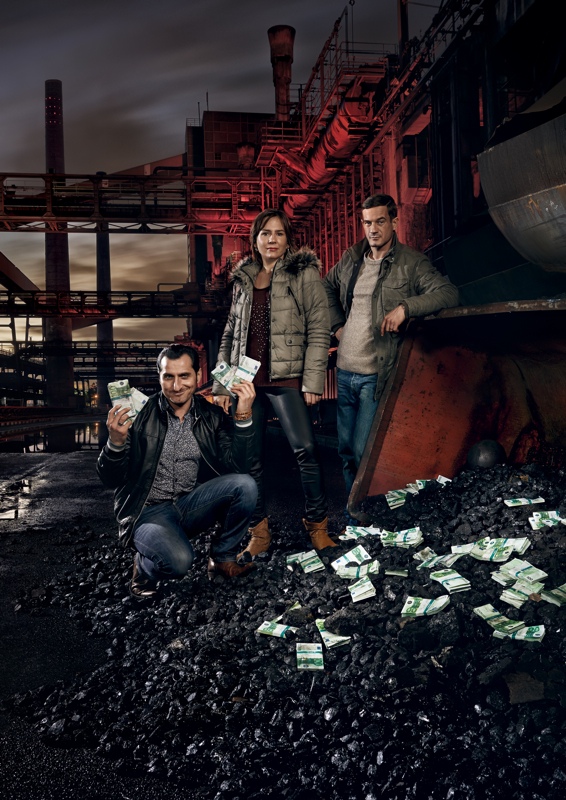
Today (ARD, 18:50) is the premiere of “Koslowski + Haferkamp” a lighthearted weekly crime show featuring three private detectives solving cases before the backdrop of the industrial city of Bochum.
Today I was wondering how fast my old MacPro (my main production machine) really is compared to the MacMini that I recently bought. And here are the results:
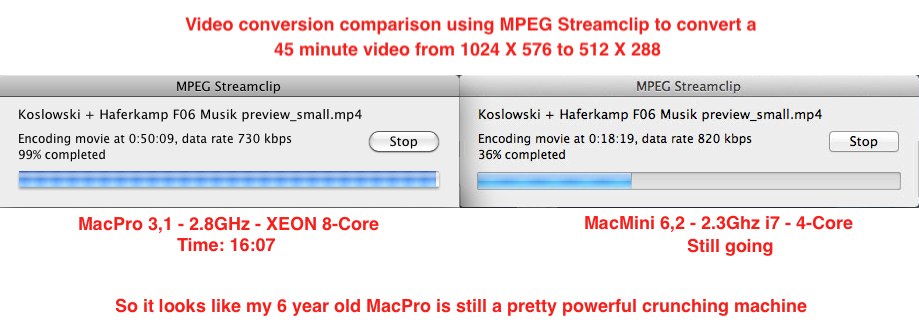
Now I’m not the biggest hardware geek but I do understand that architectures vary quite a bit and have a substantial influence over computing performance. But a 6 year old machine beating a 2 year old machine by such a big margin may be part of the reason why hardware development feels stalled: We have reached machines that are incredibly powerful.
Granted: for real-time things such as music production we would still like to squeeze every CPU cycle that we can, but hey: at least in my case I still get by with that machine and it doesn’t slow me down too much.
How much more lively this is as opposed to the strict digital tempo timelines that we have available today that sound so terribly stiff.
The morse code for the letter “V” is dot dot dot dash or …-
Morse code was created around 1840.
And now think of Beethovens 5th Symphony, created 1808.
[table]
,Show, Network, Composer
,Copper,BBC America,Brian A. Keane
Winner,Da Vinci’s Demons,Starz,Bear McCreary
,Elementary,CBS,Sean P. Callery
,Hemlock Grove,Netflix,Nathan W. Barr
,House of Cards,Netflix,Jeff Beal
,The Americans,FX Networks,Nathan W. Barr
[/table]
Congratulations to Bear McCreary and all of the nominees! Listen to the winning theme here:
Bear McCreary – Da Vinci’s Demons Main Title Theme – YouTube.
[table]
,Show,Network,Composer
,Arrested Development,Netflix,David Schwartz
Winner,Downton Abbey,PBS,John Lunn
,House of Cards,Netflix,Jeff Beal
,Last Resort,ABC,Robert Duncan
,Mr Selfridge (Masterpiece),PBS,Charlie Mole
,The Borgias,Showtime,Trevor Morris
[/table]
Congratulations to John Lunn and all other nominees!
In the past couple of weeks we’ve seen where peoples’ desire for security will lead us: to the surveillance state, as has been revealed by the publication of PRISM.
For me personally it takes me back a bit to what happened surrounding the introduction of the SOPA and ACTA bills. Back then, if you remember, “the whole internet”™ went into an uproar unlike anything ever seen in the technology world. Google went black. Wikipedia went black. Reddit went black. The world pretty much ended according to people who are more than interested in removing any individual rights that may be in the way of the tech industry moving forwards.
Where is the outrage now? Where are the demonstrations now? Where is the political youth opposing this surveillance and promoting a free civilized society based on the rule of law? Unfortunately they are nowhere and here are my thoughts about why:
In the case of the copyright debate the primary reason for the outcry was, just as many colleagues had suspected all along, purely about the filesharing aspect of the privacy debate. None of the true political implications that came along with it. And all the talk about privacy and surveillance state and the likes where smokescreens in order to justify taking away the rights (and by extension the ability to monetize their works) of millions of authors in order to personally not be liable for watching TV series, movies and listening to music without paying for it. Because, in no way would copyright lead to what this article in the guardian talks about and I share a quick quote:
Lavabit has been told that they would face serious criminal sanctions if they publicly discuss what is being done to their company. Thus we get hostage-message-sounding missives like this:
I wish that I could legally share with you the events that led to my decision. I cannot. I feel you deserve to know what’s going on – the first amendment is supposed to guarantee me the freedom to speak out in situations like this. Unfortunately, Congress has passed laws that say otherwise. As things currently stand, I cannot share my experiences over the last six weeks, even though I have twice made the appropriate requests.”
I have been of both sides of the copyright debate: when Napster came out I was just starting out in the industry and felt like the industry kept me out by design. I was happy that something “interrupted them” and “put them in their place” and defended it.
But after slowly making my way into the industry and starting to actually understand how the industry works, how the different institutions function (many of whom I still don’t agree with, but that doesn’t warrant taking away their right to exist!!) and what the struggle being a media creator supporting a family really means, but first and foremost: that the only thing I, as a media creator, have to sell is a license, I have felt the attacks of the copyleft movement to be intimately personal, vile and solely aimed at taking away my possibility to monetize my work. And for musicians and composers who don’t see the media industry as a “late teen/early twenties let’s form a band and play some cool parties for our friends” but as a way of making business with each other and who have spent countless hours practicing, studying, throwing away sketches, being unsatisfied with ideas (in short: artists struggle) it’s not quite as possible to just switch gears and work for a consultancy or social media consultancy company.
A lot of us (media creators) went into this field exactly because it is not possible for us or not desirable to live the kind of life where you have to give up a lot of your own personality and convictions in order to actively be popular and appeal to market interests. We’re all forced by market interests, that I understand. But there’s a difference with sticking to what you believe in and relinquishing it in order to “not offend”!
Authors rights have given individuals the freedom to live their dreams, to break away from trodden paths, in essence to be truly free human beings. And that is, at least to me, the ultimate goal and worth fighting for.
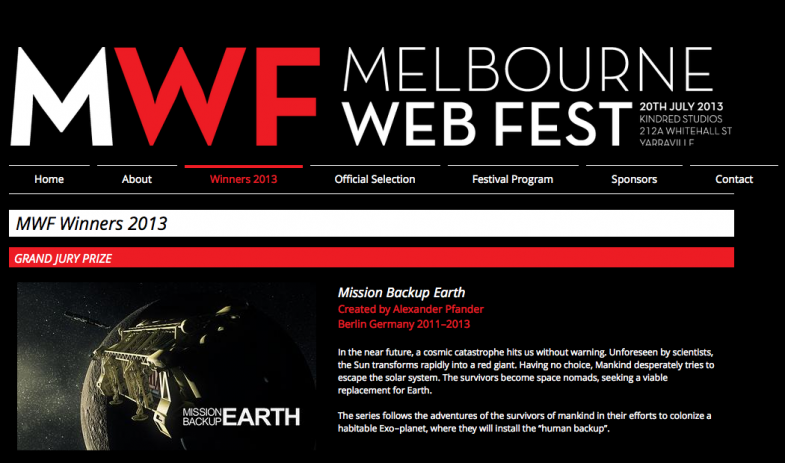
I was on the train in the lovely Schwarzwald when I received an email from our CGI artist Tony Pinkpank about his attending the Melbourne WebFest 2013. The wording was perfectly timed and the deception worked incredibly well: he surprised our whole team with the big news, that our webseries Mission Backup Earth received both the Best Fantasy/SciFi award as well as the Grand Jury Price!
I’m very proud to have contributed the music to this series! It would be great if we could develop the series’ storyline and characters further and perhaps into a longer form 40 minute episode drama series! What a dream-come-true that would be…
We’re all very excited and the crew in Berlin had a little spontaneous street party that I would have loved to attend, but being on my sisters remote horse farm is very nice as well!
You can watch all the episodes on YouTube
The spotting session is a crucial step in the filmmusic creation process: This is where the director, possibly the editor and music editor (if there is one) and the composer develop the broad concept for the filmmusic as well as discuss the fine details.
This is the time of experimentation. It’s very exciting and there are no limits in this meeting. If everyone keeps an open mind it can be a fun process of trial and error to see what effect a certain type of music will have on a scene. I’m often surprised myself that something that I imagined would never work for a particular scene can turn out to be very complementary to the picture and add great depth.
Deciding on music and where it comes in and goes out is really something that can not be talked about but that has to happen on a personal level. It’s important to get a direct feel for a reaction to be able to refine the communication between all parties involved.
I read this very noteworthy article recently on the sustainability of the music subscription services and here are my thoughts on it.
I’m sure Spotify can be very successful and profitable in just offering those all-time mega hit songs and the summer hit songs. Those songs tend to engage the audience throughout their lifetime.
But when you look at what kind of service that would make, it seems to me to be the model of the “oldies but goodies” radio stations. A very conservative form of both media “broadcast” (in the wider sense not the technical sense) and listener behavior.
Would spotify as a service that focused only on those all-time-great songs and not on a catalogue as big as possible be an attractive place for the curious music lover?
I remember an instance in 2006 or 2007 when I visited my friends in Los Angeles and drove around in my rental car listening to the world famous KROQ. What happened was that I felt like every time I turned on the station and drove for about 45 minutes (the average drive time in LA) I would hear
* City of Angels, Red Hot Chilli Pepper
* Enter Sandman, Metallica
* The Pretender, Foo Fighters
This is all fine and dandy, they can play whatever they want and how often they want, that’s not my point and on top of that, I love those songs.
But from a curious listener standpoint those forms of media are becoming less and less interesting to me. I would like to explore new songs, find voices I haven’t heard before, dive into the experimental, challenge my taste expand my horizon and so on. Which is where all the indie artists come into play that make up the bulk of Spotfiys catalogue and in my opinion, they make up the real attractiveness of the service.
Unfortunately for those artists, music subscription services will never amount to a reasonable or even noteworthy level of income stream as the calculations in the article reveal. But the calculations in the article make it abundantly clear that the royalty rate that the subscription services pay today are the only ones that are viable with the currently assumed listening behavior. I get that and I respect that. Please read the section on the promotional aspects in the article for consideration of that argument. Basically subscription based music consumption promotion will lead to more subscription based music consumption and as such to the lowest possible roaylty for the artist.
Subscription services are great discovery tools if they actually work at presenting you things that you don’t know. But if you truly would like to support an artist, there is no other and no better way than to purchase the music from him or her directly. And hopefully the artists retained enough rights to the music to be able to sell on a distribution platform that has a fair revenue sharing model. I don’t want to advertise any, we can discuss them in the comments if you like.